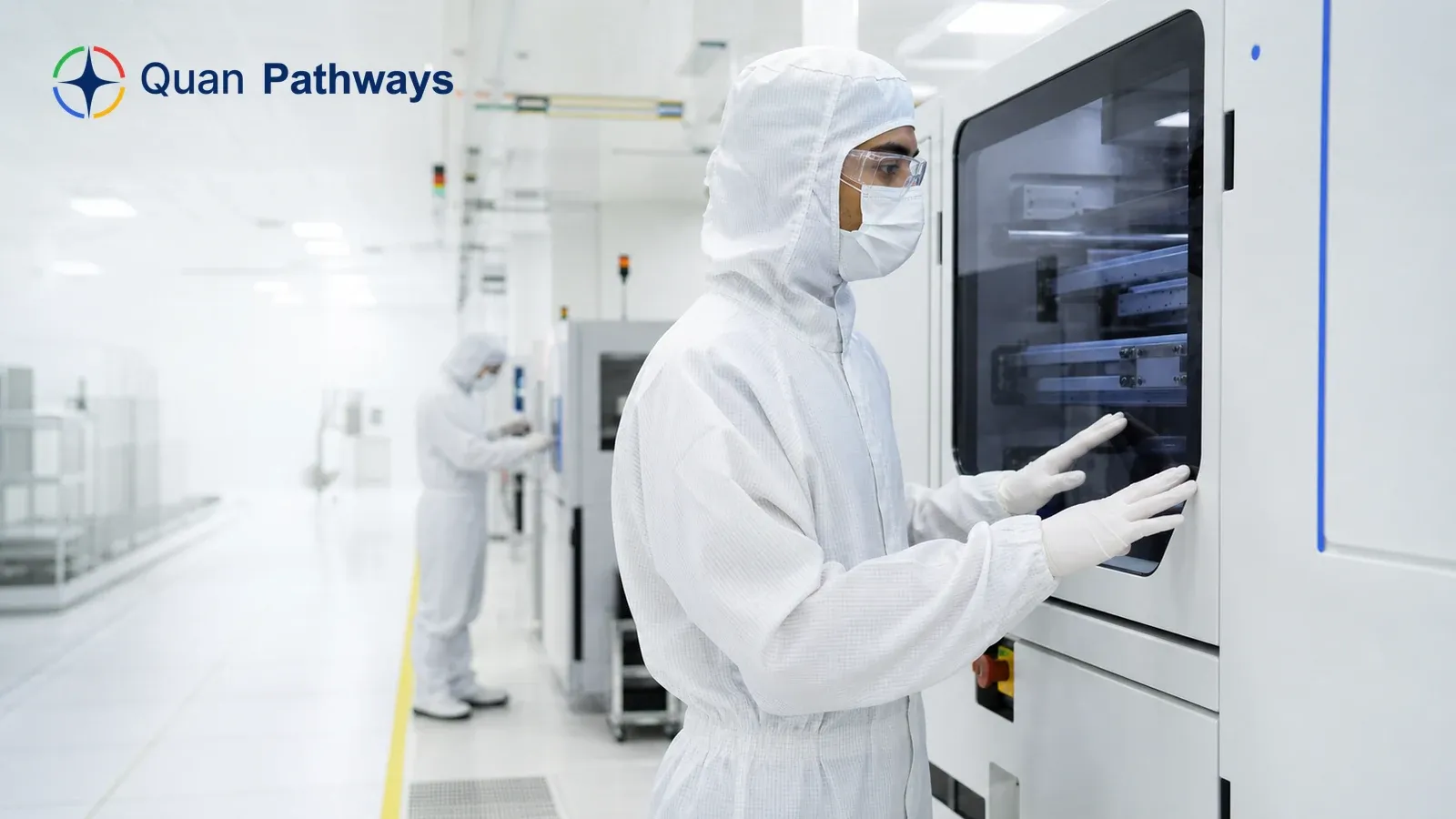
“Semiconductor technician” is an umbrella phrase. One person may watch production systems, another may maintain manufacturing equipment, and another may keep the fab’s water, electrical, mechanical, controls, gas, or chemical systems operating safely. The title alone does not tell you the daily work.
First, separate occupation information from a curriculum
The Bureau of Labor Statistics profile and O*NET record describe occupation-level work across many employers. They are useful for understanding common tasks and conditions, but they do not define a specific employer role or college curriculum.
An employer apprenticeship page describes that employer’s roles. A college catalog describes that college’s courses. Always compare both with the current job posting rather than treating one source as a universal checklist.
Process and production technicians
BLS says semiconductor processing technicians may review work orders and process charts, set or adjust manufacturing controls, monitor equipment, test wafers or completed chips, and suggest process improvements. In plain language: they help keep a tightly controlled production step running within its required settings and notice when results drift.
A specific employer can divide this work differently. TSMC Arizona describes its process technician as monitoring wafer manufacturing, responding to alarms, analyzing process information, following standard operating procedures, and working with a team on production efficiency and quality. That description belongs to TSMC Arizona’s published program, not every fab.
Equipment technicians
Equipment technicians concentrate on the tools that perform manufacturing steps. TSMC Arizona’s published equipment role includes preventive maintenance, cleanroom error response, visual inspection, quality checks, and continuous improvement on semiconductor equipment.
O*NET lists inspecting production equipment, diagnosing malfunctions, maintaining equipment, and notifying others about repair needs among related work activities. Depending on the employer and tool, technicians may perform approved maintenance themselves or escalate work to another specialist.
Facilities technicians
A fab also depends on building-scale systems. TSMC Arizona’s facilities description covers operating, maintaining, and troubleshooting gas and chemical, water, mechanical, electrical, and instrumentation-and-control systems while following standard operating procedures.
Facilities work is not the same as running a wafer process or repairing a production tool. When evaluating a role, ask which system you would support, where the work occurs, what licenses or technical background are required, and how emergency response is handled.
Documentation and quality are part of the job
BLS says technicians capture process data and record testing documentation that helps engineers investigate production problems. O*NET likewise lists maintaining processing, production, and inspection reports, measuring products against specifications, and recording operational data.
This means careful documentation is production work, not paperwork added at the end. A missed entry, unreported alarm, or skipped procedure can make it harder for the next person to understand what happened.
Cleanroom behavior protects the product
BLS explains that cleanrooms filter impurities that could damage microchips and that technicians wear special garments over their clothing to limit contamination.
BLS also says newly hired technicians typically receive on-the-job training in working in a cleanroom, operating equipment, and testing chips. The details vary by employer, so ask how a program teaches cleanroom work and follow the procedures provided for your assigned site and task.
Shifts can be part of the fit decision
BLS reports that most semiconductor processing technicians work full time and that shift work commonly includes early mornings, nights, or weekends because manufacturing facilities may operate around the clock.
Before accepting any training or job, ask for the actual shift pattern: hours per shift, rotating versus fixed schedule, weekends, overtime expectations, school conflicts, and transportation at the start and end times. “Full time” does not tell you any of those details.
Chemical, gas, and protective-equipment safety
O*NET reports that protective or safety equipment is common in this occupation and records exposure to contaminants and hazardous conditions in its work-context data. It also lists chemical baths and process materials among tasks in the broad occupation. Those data do not tell you the hazards of a particular job.
TSMC Arizona’s facilities example specifically includes gas and chemical systems, while its equipment description says work must support environmental, health, safety, and security requirements. A candidate should ask which substances or energy sources are present, what protective equipment and training are required, how exposure is monitored, and which tasks an entry-level technician is authorized to perform. BLS describes cleanroom garments as contamination control; verify rather than assume what protective equipment a particular task requires.
Communication and teamwork keep handoffs clear
BLS identifies communication as important because technicians convey observations and improvement recommendations to engineers and others. TSMC Arizona’s process description also places technicians with a team and leadership while managing production efficiency and quality.
Useful communication is concrete: state the tool or process, time, alarm or observation, action already taken, procedure followed, and who needs the next handoff. Asking for clarification before acting is a safety and quality habit, not a weakness.
Training is broader than one job description
SEMI’s SCAN workforce model separates baseline instruction from employer-site on-the-job and specialized training. NIST’s CHIPS workforce page identifies semiconductor workforce development as a national priority. Neither source defines the curriculum or opening status of a specific employer program, so use them as context and verify the local details.
Questions to ask before choosing a pathway
- Which track is this: process/production, equipment, or facilities?
- How much of the shift is at a workstation, in a cleanroom, or around facility systems?
- Which standard operating procedures, documentation systems, and quality checks will I learn?
- What shift will I train on, and can it change?
- What protective equipment, physical demands, and safety training apply?
- Who supervises and mentors me, and how are errors or alarms escalated?
- Is there a current employer application, or only a permanent program page?
Use the reviewed Advanced Manufacturing directory to compare direct semiconductor and transferable manufacturing pathways. Current openings remain unverified unless a profile identifies a current applicant action; reconfirm the job, schedule, environment, and training with the sponsor.
Research reviewed August 23, 2026. Work assignments, safety controls, schedules, curricula, and recruiting status are employer- or program-specific and can change.