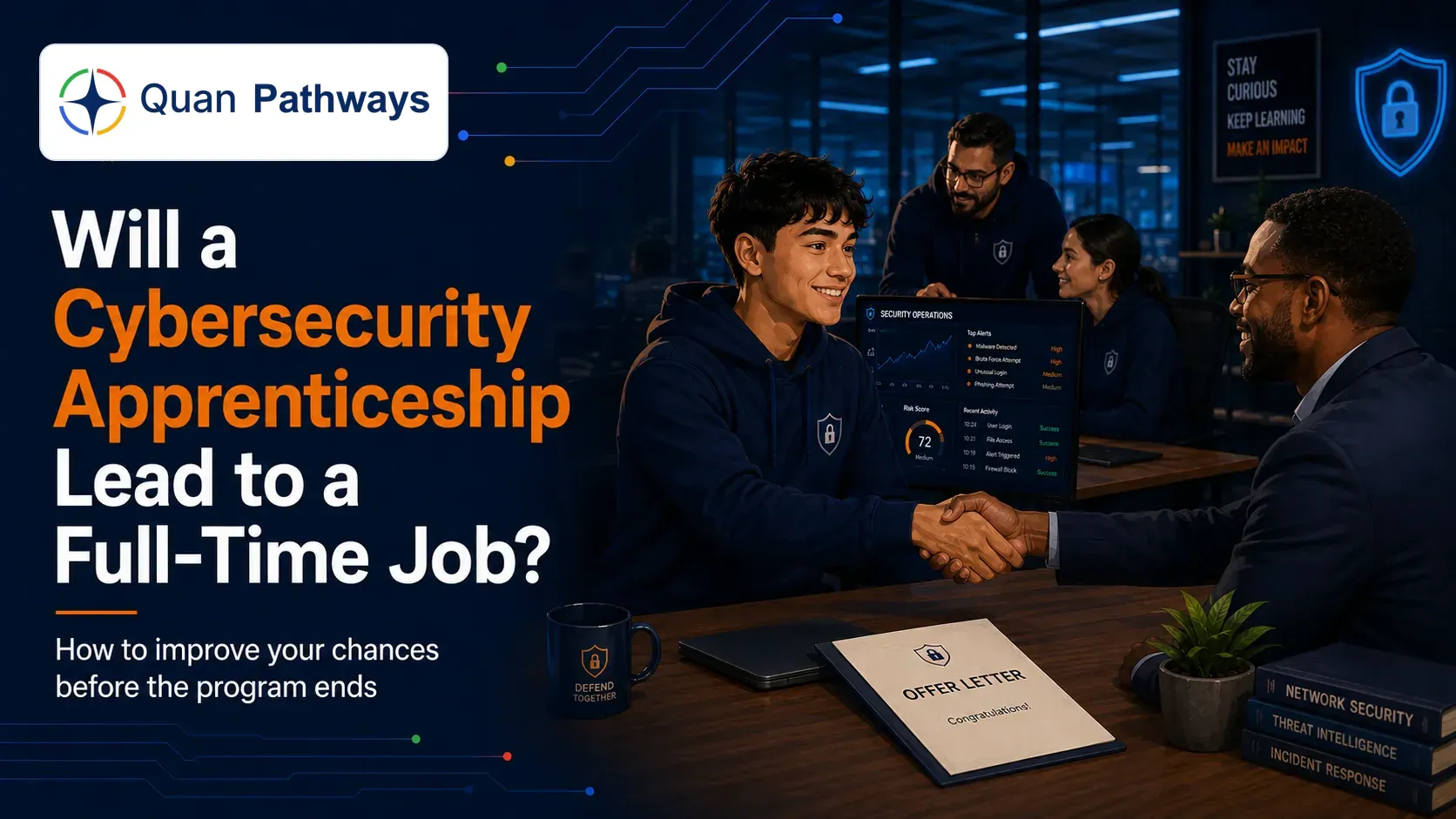
How to improve your chances before the program ends.
One of my daughters had a technology-related internship while she was still in college.
The internship did more than add another line to her résumé. It gave the employer time to watch how she learned, communicated, handled responsibility, and worked with other people.
She received a full-time offer before graduating.
I remember that experience because it shows work-based learning at its best. A résumé tells an employer what a candidate claims to know. Several months of real work allows the employer to see whether the person is actually becoming valuable.
A cybersecurity apprenticeship can create that same kind of opportunity.
But the word can matters.
An apprenticeship may lead to a permanent position. It can also make a person much more competitive for jobs elsewhere. What it cannot do is guarantee that the employer will have a permanent opening when the program ends.
The honest question is not simply, “Will this lead to a job?”
The better questions are:
What can I learn about the employer’s intentions before I accept, and what can I do during the program to give that employer strong reasons to keep me?
An Apprenticeship Is Already a Job
A Registered Apprenticeship is not simply a training program that promises employment later.
The apprentice is already a paid employee. The program combines that employment with structured workplace learning, mentorship, related instruction, wage progression, and a recognized credential.
That is an important distinction.
Someone completing a general cybersecurity course may still have to persuade an employer to take a chance on them afterward. An apprentice is already inside an organization, learning its systems, working with its people, and demonstrating value over time.
But being employed during the apprenticeship does not automatically answer what happens after completion.
Some employers create apprenticeships as long-term hiring pipelines. Others may depend on future budgets, contracts, staffing needs, grants, or the availability of permanent positions.
Students should never assume the answer.
They should ask.
What the Retention Statistics Really Mean
Apprenticeship.gov cites employment retention of roughly 90 percent for people who complete Registered Apprenticeships.
That is encouraging. It tells us that apprenticeships, as a broad workforce model, often connect people to lasting employment.
But it does not mean that every individual apprentice has a 90 percent chance of receiving a permanent job from the same employer.
Apprenticeship.gov footnotes that figure as based on Kansas Department of Commerce data. It is useful evidence that the apprenticeship model can support retention, but it is not a national probability or a guarantee for a particular cybersecurity opportunity.
This is exactly where statistics need to be translated into practical advice.
The apprenticeship model works partly because employers invest time and money in training people for work they actually need. That creates a stronger connection to employment than training that takes place entirely outside the workplace.
Still, every student has to evaluate the specific program in front of them.
Questions to Ask Before You Accept
Students often become so focused on being selected that an offer feels like the finish line.
It is not. It is the beginning of a two-way decision.
Before accepting, ask the employer or program sponsor:
-
Is successful completion normally followed by continued employment?
-
How many people have completed this specific apprenticeship?
-
How many received permanent offers?
-
Were they hired by the same team, another department, or a partner employer?
-
What standards define successful completion?
-
Who makes the hiring decision, and when is it usually made?
-
Are permanent positions already planned, or will hiring depend on future openings?
-
What happens to strong apprentices when the employer cannot offer them a position?
-
Can I speak with a current or former apprentice?
A credible employer may not be able to promise a permanent job. Business conditions change, and no responsible organization can guarantee an opening that does not yet exist.
But the employer should be able to explain the normal pathway.
“Many of our successful apprentices receive offers, depending on performance and available positions” is a reasonable answer when the organization can describe its history.
“Don’t worry about it” is not.
Look at How Much the Employer Is Investing
The quality of the employer’s investment tells you a great deal.
An organization that assigns an experienced mentor, provides structured instruction, increases responsibility, and teaches apprentices how its systems and teams actually work is making a serious commitment.
That commitment does not guarantee permanent employment, but it suggests the apprentice is being developed as a potential long-term contributor.
The opposite is also true.
If apprentices spend most of their time in generic online training, have little contact with actual teams, and cannot identify who will supervise their work, the employer has fewer opportunities to see them as future employees.
The most useful question is not merely, “Will I receive training?”
It is:
Will the people who may eventually hire me have enough opportunity to see the quality of my work?
Behave Like a Future Employee
Once the apprenticeship begins, the apprentice should stop thinking like a temporary visitor.
Show up prepared. Meet commitments. Take notes. Follow security and privacy rules carefully. Communicate early when something is unclear or when a deadline may be missed.
Those habits sound basic, but they matter enormously.
Cybersecurity teams work with risk, confidential information, and systems that other people depend on. An apprentice who is technically curious but unreliable creates a problem. An apprentice who is careful, honest, and consistent becomes someone the team can gradually trust.
Trust is one of the most valuable things an apprentice can build.
Learn the Business, Not Just the Security Tools
A security alert is not important simply because it appears in red on a dashboard.
It is important because of the system involved, the people who use it, the information it contains, and what could happen if that system were disrupted.
The apprentice who understands the business will usually become more useful than the person who only knows where to click.
Ask what the organization does. Learn which systems are critical. Understand who the customers are, what information must be protected, and how security decisions affect operations.
This was true throughout my own technology career, including my years at Proofpoint. Technical knowledge mattered, but the most valuable people understood why the work mattered to the organization.
Cybersecurity is not separate from the business.
It protects the business.
Ask for Feedback Before the Final Evaluation
One of the biggest mistakes an apprentice can make is waiting until the program is almost over to ask how they are doing.
Feedback is most useful when there is still time to act on it.
An apprentice should regularly ask what is going well, where too much guidance is still required, and what would justify more responsibility.
The most important question may be:
What would I need to demonstrate to be considered for a permanent role?
That question turns a vague hope into a development plan.
The answer may involve clearer documentation, stronger technical fundamentals, better communication, more initiative, or a particular type of project experience.
Whatever the answer is, the apprentice can begin working on it while the employer is still watching.
Document Your Accomplishments
Apprentices should keep a private, nonconfidential record of the work they perform.
That record might include projects, responsibilities, tools used, feedback received, and measurable results.
It should never contain customer information, internal screenshots, source code, security weaknesses, confidential procedures, or proprietary material. The goal is not to take the employer’s information. The goal is to remember enough to describe the experience accurately later.
CISA advises applicants to explain what they were asked to do, how they approached the work, who was affected, and what result they helped produce.
That means “reviewed security alerts” is only a starting point.
A stronger explanation would be:
Reviewed lower-risk security alerts under analyst supervision, documented initial findings, and followed the team’s escalation process.
Someone working with access controls might say:
Supported user-access reviews across several departments, tracked exceptions, and coordinated follow-up with system owners.
The claims must be truthful. The numbers must be accurate.
But the apprentice should leave with more than the memory of being busy. They should be able to explain how their work created value.
Build Relationships Beyond One Mentor
A strong mentor can transform an apprenticeship, but hiring decisions may involve managers, technical leads, human resources, and employees from other teams.
Apprentices should participate professionally, ask thoughtful questions, and become known for the quality of their work.
That does not mean artificial networking or constantly trying to impress people.
It means becoming part of the workplace.
When other employees begin to trust the apprentice, include them in discussions, and ask for their help, the person is no longer being viewed only as a trainee.
They are beginning to look like a colleague.
What Employers Are Really Evaluating
Technical improvement matters, but employers are rarely evaluating technical skill alone.
They are also watching whether the apprentice can solve problems without acting recklessly, accept correction without becoming defensive, communicate with technical and nontechnical people, protect confidential information, and take ownership when something goes wrong.
CISA identifies qualities such as attention to detail, communication, customer service, and problem solving as important cybersecurity competencies.
The practical translation is simple: employers want someone they can trust around difficult problems.
The most knowledgeable apprentice on the first day is not always the one who receives the offer.
The person who learns steadily, communicates clearly, and takes responsibility may become much more valuable by the end.
When There Is No Permanent Offer
A successful apprenticeship should still create value even when the employer does not extend a permanent offer.
The apprentice should leave with a recognized credential, documented workplace experience, professional references when appropriate, and a much clearer understanding of which cybersecurity roles fit their strengths.
They should also leave with specific accomplishments they can explain in future interviews.
Before departing, the apprentice should ask whether the supervisor can serve as a reference, whether other departments or partner employers are hiring, which roles best match the work completed, and what skill should be developed next.
A no-offer outcome can be disappointing.
It should not erase the value of the experience.
The apprenticeship may still be the bridge to the next employer.
Our View
An apprenticeship is both a job and a bridge.
It is a job because the apprentice is being paid to contribute and learn inside a real organization.
It is a bridge because that experience can connect a beginner to a longer career, whether the next position is with the same employer or somewhere else.
My daughter’s internship led directly to a full-time opportunity because the employer had enough time to see the quality of her work before she graduated.
My own apprenticeship became the beginning of a long technology career because it gave me structured learning, real responsibility, and a chance to prove that I could grow.
Neither story means every program produces the same outcome.
At Quan Pathways, we never promise that an apprenticeship guarantees a permanent cybersecurity job.
We promise to help students ask better questions, examine the employer’s history, understand the quality of the training, and use every month of the program to build visible evidence of capability.
The right expectation is not:
A job will be waiting for me.
It is:
I will use this opportunity to learn, contribute, and give the employer strong reasons to keep me.
That is more honest.
It is also far more powerful.
Use our reviewed cybersecurity apprenticeship directory to compare current opening information and investigate each employer’s pathway.
Research reviewed August 5, 2026. Continued employment depends on performance, employer needs, and available positions; ask the sponsor for program-specific outcomes. Send us a correction.